I’ve been thinking about how community can help me find the work I want to do and build a path toward it. A friend’s experience gives me a concrete starting point for exploring that process.
The framework
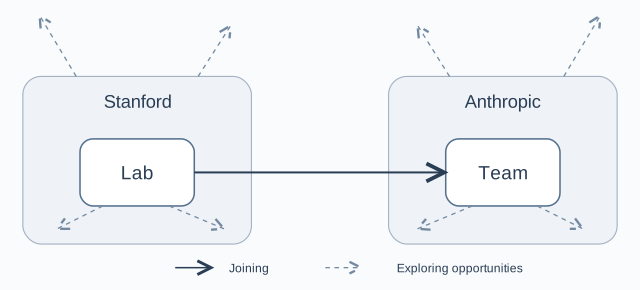
Two layers of community
The broader community: shared identity and reach. Organizations such as universities and companies provide resources, wider information networks, and a shared identity. That identity may make it easier to start a conversation, but it does not amount to a deep understanding of an individual's capabilities.
The smaller community: working together and getting to know one another. Labs and teams provide settings for sustained collaboration. People see how others think, solve problems, and take responsibility. Over time, they develop an informed appreciation of one another's abilities.
Three conditions a broader community can provide
| Condition | How it works | What it enables |
|---|---|---|
| Access within the organization | Membership and internal channels for participation create openings to approach or join specific teams. | This may lower the barrier to entering a smaller community, turning an existing affiliation into an opportunity for deeper involvement. |
| Exchange within the organization | A shared identity and internal channels of communication make it easier for people across teams to start conversations. | This broadens access to information about different problems, perspectives, and potential collaborations. |
| External credibility | An organization's recognizable identity and reputation give others an initial sense of a person's background. | This may make people outside the organization more willing to respond or engage, extending access to information and connections. |
Three things we build through close collaboration
| What we build | How it develops | What it enables |
|---|---|---|
| A body of work | We take responsibility for concrete problems and complete research or systems work, producing contributions that others can see and evaluate. | This makes our capabilities visible and gives others concrete evidence when considering whether to collaborate with us. |
| Learning | We observe how others think, participate in solving problems, and learn through feedback and revision in day-to-day work. | We turn others' experience into methods of our own, improving our ability to understand and solve problems. |
| Trust | We demonstrate capability and reliability through sustained collaboration, allowing others to develop an informed understanding of what we can do. | Collaborators become willing to work with us again, recommend us, or introduce us to others, helping open the next opportunity. |
These three develop alongside and reinforce one another: making visible contributions, continuing to learn through practice, and building trust through collaboration.
A broader community provides openings and a wider flow of information. A smaller community turns some of those possibilities into experience, contributions, and trust through actual collaboration. What we build then helps open the next connection.
Moving between communities
| Part of the process | The central question | What it draws on |
|---|---|---|
| Exploration | Why do I want to work with them? | Information and conversations across both broader and smaller communities help us discover, understand, and choose opportunities. |
| Building a foundation | Why would they want to work with me? | Actual capability and contributions, together with the recognition and recommendations of collaborators. |
Exploration helps us find somewhere worth going. What we have built gives others a reason to welcome us.