About me

Hi, everyone! I'm Yuming (Harry) Feng. As a current MS student in Electrical Engineering at Stanford University, I'm driven by the excitement of the AI era and motivated to push cutting-edge technology into the real world. My work spans recommendation systems, LLM agents, and robotics & RL, where I love turning bold ideas into practical, working systems that create real impact and benefit others.

What i'm doing

  • RecSys

    Ranking, retrieval, long-term value modeling, and evaluation for recommendation and discovery systems.

  • LLM Agents

    Memory, tool use, multi-agent coordination, reinforcement learning from feedback, and evaluation for agentic systems.

  • Robotics & RL

    Multi-agent robot learning, sim-to-real transfer, hierarchical control, and long-horizon planning for embodied systems.

Experience

Education

  1. Stanford University

    Master of Science, Electrical Engineering (expected) Sept. 2025 – Jun. 2027 (expected) · Stanford, USA

    Coursework: Deep Learning, Natural Language Processing with Deep Learning, Human-Centered LLMs, Apps with LLMs Inside, Understanding Users

  2. Carnegie Mellon University

    Advised by Prof. Ding Zhao (CMU) and Prof. Jie Tan (Google DeepMind) Feb. 2024 – Oct. 2024 · Pittsburgh, USA

    Visiting scholar, Mechanical Engineering. Multi-agent collaborative manipulation and long-horizon quadrupedal pushing.

  3. Peking University

    Bachelor of Science, Physics Sept. 2021 – Jun. 2025 · Beijing, China

    Coursework: Introduction to Computation, Data Structure and Algorithm, Multi-Agent Systems, Thermodynamics and Statistical Physics, Quantum Mechanics

Professional experience

  1. Recommendation algorithm intern · TikTok Live

    Jun. 2026 – Sep. 2026 · San Jose, USA Internship · TikTok Live

    Designed a TikTok Live long-term value ranking target for US For You mixed ranking, modeling user-creator "app-open reason for live" labels on T+1.

  2. AI product builder · AI Tutor

    Mar. 2026 – Jun. 2026 · Stanford, CA Entrepreneurial project · AI Tutor

    Built an end-to-end pipeline converting traditional tutoring PDFs into AI-ready corpora, using VLM/OCR parsing, structured Markdown normalization, corpus splitting, problem-bank construction, and embedding retrieval for grounded tutoring.

    Designed a curriculum-grounded agent system for Chinese math exams with structured solve outputs, problem-bank RAG, user-level memory, and a sandboxed drawing subagent for Python-generated SVG explanations.

    Built an exam-paper evaluation harness over recent regional exams, showing our agentic pipeline improved curriculum fit by 32% and correctness by 9% over the base frontier model.

  3. AI product builder · IdeaWeave

    Dec. 2025 – Mar. 2026 · Stanford, USA Entrepreneurial project · IdeaWeave

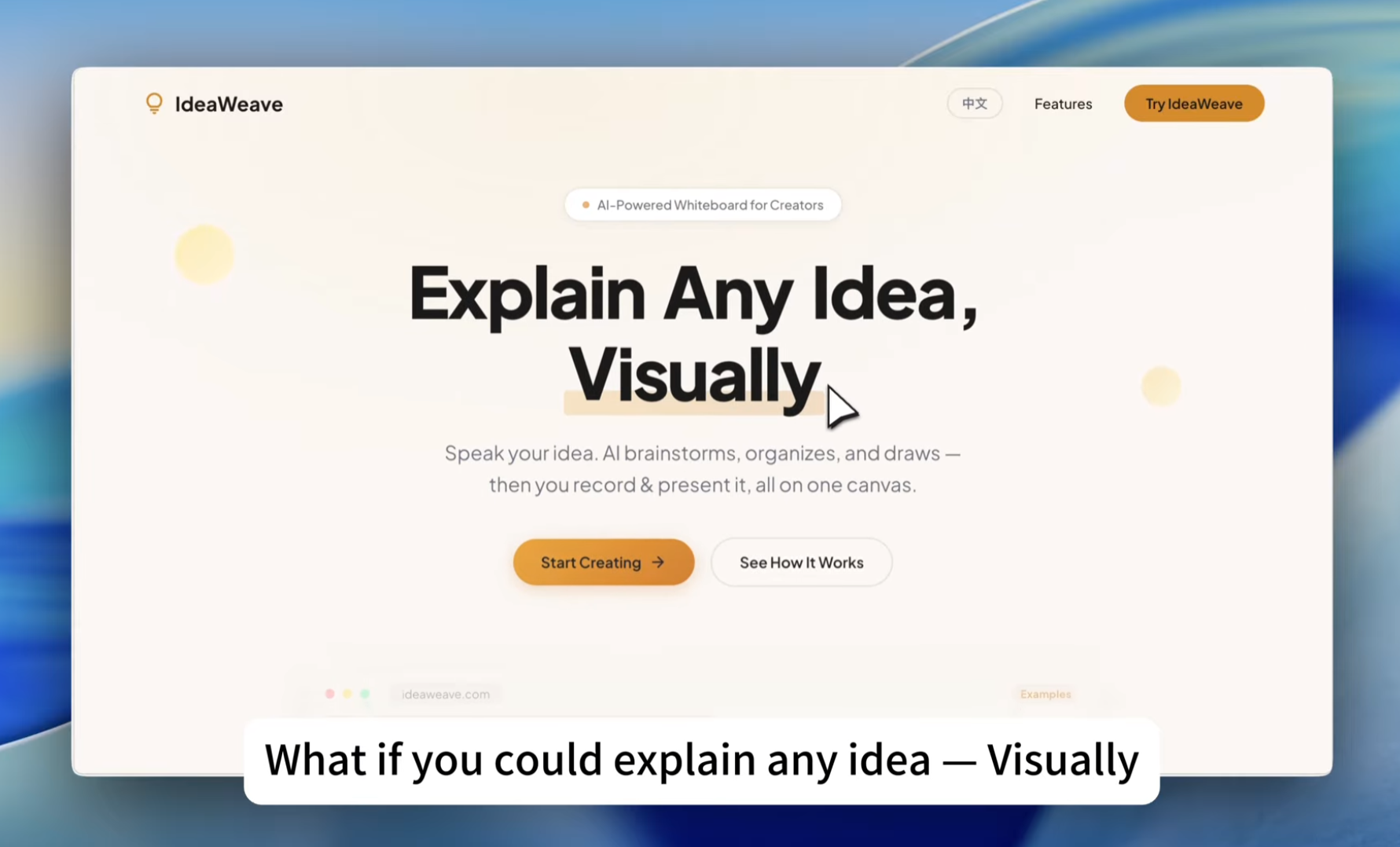
    Launched a multi-agent diagram generation product that turns intent into editable diagrams through clarification, generation, canvas refinement, and one-click recording; reached 10K+ impressions and 300+ users.

    Designed a telemetry-driven iteration loop around the Planner-Judge-Executor-Validator agent architecture, capturing artifacts and failure modes to support systematic prompt/model debugging and workflow refinement.

    Reduced generation cost by about 87% and latency by about 60% through DSL compilation, model routing, and prompt caching while preserving output quality.

  4. Machine learning infrastructure intern · Galbot

    Mar. 2025 – May. 2025 · Beijing, China Internship · Galbot

    Consolidated fragmented training stacks across simulation backends and ML frameworks into a unified JAX + MuJoCo Playground platform, standardizing configuration and reducing cross-task maintenance.

    Validated the end-to-end ML workflow from policy training and simulation evaluation to deployment handoff, reducing training time by 37% versus the previous fragmented workflow.

    Documented configuration, debugging, and deployment handoff workflows to lower onboarding costs, standardize experiment transfer, and support cross-team integration.

Project experience

  1. Empirical study of LLM alignment and fine-tuning strategies

    Jan. 2026 – Mar. 2026 · Stanford, USA Independent research project under Stanford CS 224N

    Built a reproducible evaluation harness for small-model LLM alignment, measuring task performance and optimization behavior across SFT, DPO, full fine-tuning, and LoRA under matched data and metric settings.

    Tested GPT-2 (124M) on paraphrase detection and sonnet generation, showing that DPO gains are limited in small-model, low-data regimes and depend on task format, data scale, and SFT baseline strength.

    Quantified adaptation trade-offs: full fine-tuning outperformed LoRA by about 3% Acc/F1, while LoRA enabled up to 2x larger batch sizes under the same compute budget.

  2. SumForU — LLM alignment for persona-steerable review summarization

    Sept. 2025 – Dec. 2025 · Stanford, USA Independent research project under Stanford CS 329X

    Trained persona-steerable review summarization with SFT (asymmetric distillation) plus RLAIF (PPO), gaining ~70% on average across key metrics vs. the base model.

    Built a full evaluation system with rule-, LLM-, and user-based metrics, analyzing how these signals correlate with each other and with the model’s observed effectiveness in practice.

  3. NoveltyRank — LLM-based retrieval-augmented novelty estimation

    Sept. 2025 – Dec. 2025 · Stanford, USA Independent research project under Stanford CS 230

    Formulated conceptual novelty estimation as a pairwise ranking problem rather than only binary classification, raising the evaluation ceiling from 32% F1 to 75% agreement.

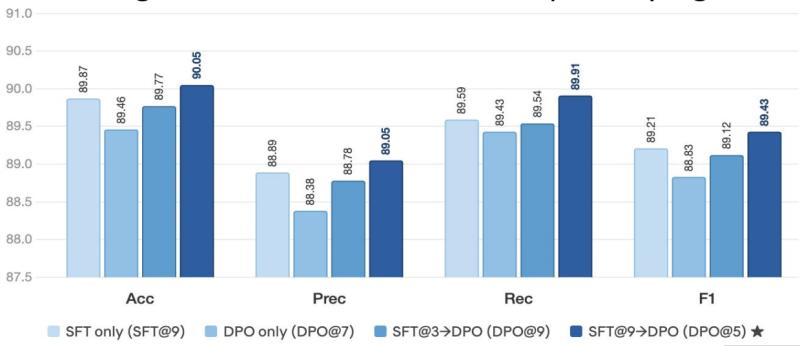
    Built a retrieval-augmented LLM training pipeline where FAISS neighbors and LLM-generated similarity reports form comparison context; used SFT to teach Qwen3-4B the pairwise novelty-judgment format, then applied DPO on preference pairs to optimize ranking decisions.

    Benchmarked compact encoder models, fine-tuned Qwen3-4B, and zero-shot frontier models, showing that task-specific supervision and semantically aligned comparison pairs matter more than raw model scale.

Research experience

  1. Multi-agent long-horizon quadrupedal pushing

    Feb. 2024 – Oct. 2024 · Pittsburgh, USA Advised by Prof. Ding Zhao (CMU) and Prof. Jie Tan (Google DeepMind)

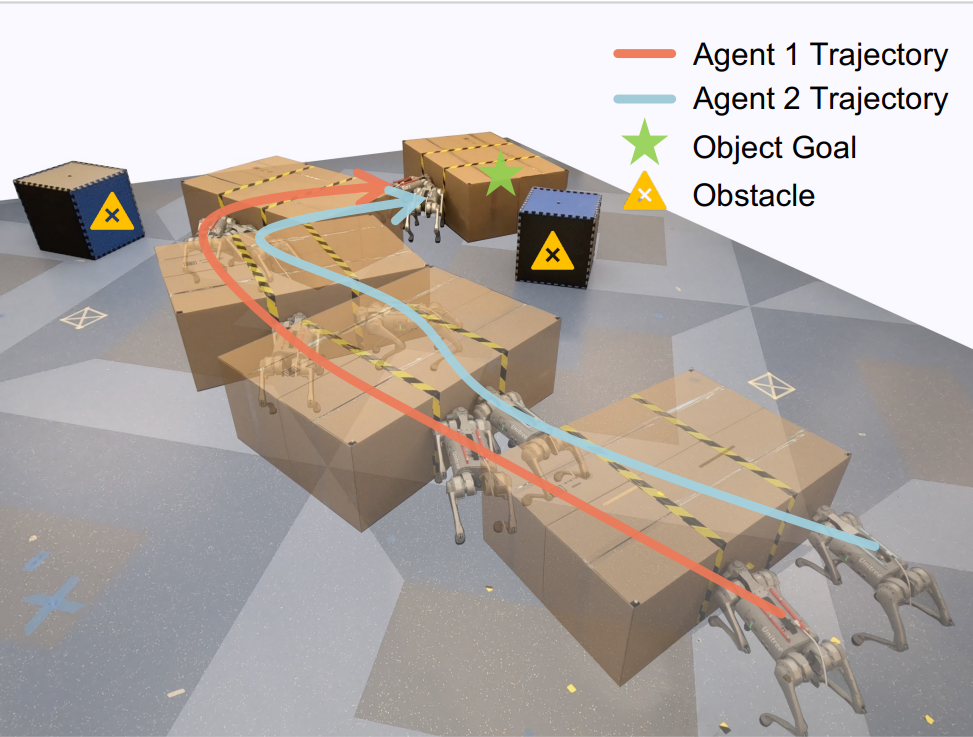
    Proposed a three-level hierarchical MARL framework for long-horizon quadrupedal pushing: RRT plus a centralized adaptive policy generates object subgoals, a decentralized goal-conditioned policy coordinates quadrupeds, and a pretrained locomotion policy executes local motion, improving success rate by 36.0% and reducing completion time by 24.5% over best baselines.

    Designed an Occlusion-Based (OCB) reward to guide agents toward better contact points on the target object, improving average success rate by 49.5% in ablation.

    Enabled Sim2Real transfer using friction-based domain randomization and deployed the policy on real Unitree Go1 Team, pushing T-shaped blocks and cubes for 10-20 m at 0.5 m/s.

    Published at IEEE ICRA 2025.

  2. Collaborative planar pushing in cluttered scenes

    Sept. 2023 – May. 2024 · Beijing, China Advised by Prof. Meng Guo, Peking University

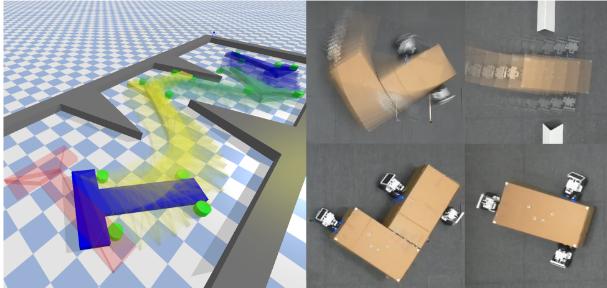
    Proposed a hybrid search algorithm that decomposes mode sequences and navigation paths to generate feasible cluttered-scene pushing trajectories, reducing execution time by 18% and improving trajectory smoothness by 67.8% over uniform path partitioning.

    Proposed a fast, scalable multi-agent contact-mode switching algorithm; used the intermediate value theorem to prove 100% collision-free switching and establish a theoretical time bound for a single mode switch.

    Validated the planning-control pipeline in PyBullet with 100% multi-scenario success and approximately 0.03 m simulation tracking error, then deployed it on ROS hardware with less than 0.05 m tracking error.

    Published at Robotics: Science and Systems (RSS) 2024.

Publications

  1. Learning multi-agent collaborative manipulation for long-horizon quadrupedal pushing

    IEEE International Conference on Robotics and Automation (ICRA) 2025

    Yuming Feng, Chuye Hong, Yaru Niu, Shiqi Liu, Yuxiang Yang, Wenhao Yu, Tingnan Zhang, Jie Tan, Ding Zhao

  2. Collaborative planar pushing of arbitrary objects with multiple robots in complex scenes

    Robotics: Science and Systems (RSS) 2024

    Zili Tang, Yuming Feng, Meng Guo

Project